

Deep Low-End Authority Without Sacrificing Clarity
Why Modern Bass Speakers Are Better Than Ever — And Why They No Longer Ruin Sound Quality
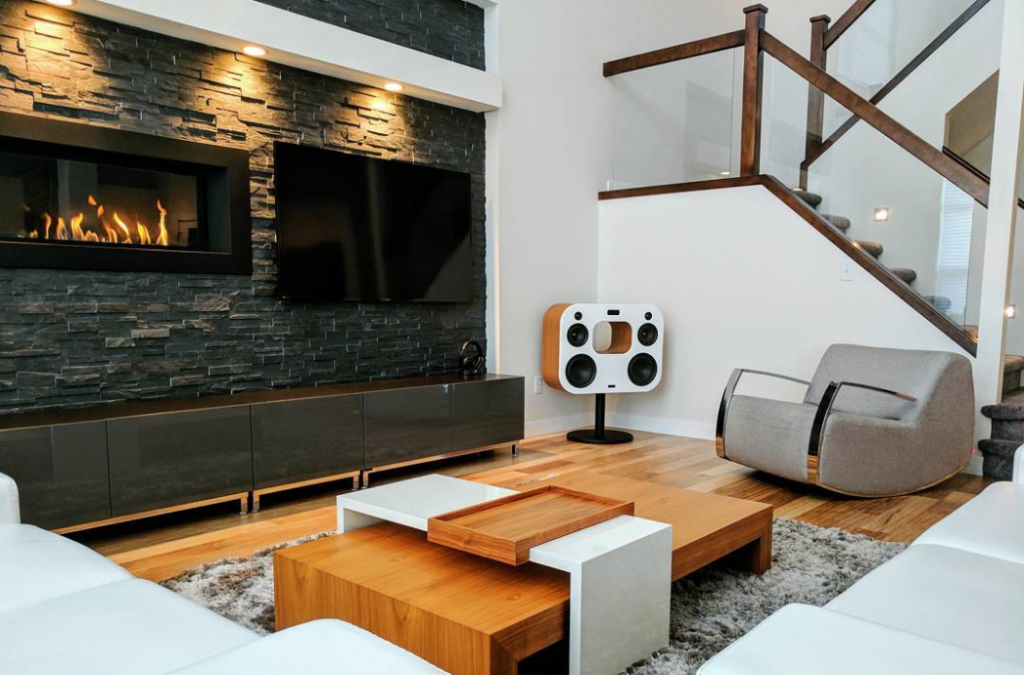
There was a time when “bass-heavy speaker” meant one thing: boom.
Bloated mid-bass.
Muddy vocals.
Shaky cabinets.
Distortion at higher volume.
If you grew up hearing early home theater systems or budget party speakers, you probably remember that type of bass. It was loud, but not clean. Powerful, but uncontrolled.
That era is over.
In 2026, premium studio stereo speakers — even bass-capable ones — no longer sacrifice clarity for low-end weight. Advances in driver engineering, cabinet design, DSP processing, and amplifier integration have changed what’s possible from a two-speaker setup.
Today’s bass-capable home studio speakers use:
- High-excursion woofers with controlled cone movement
• Rigid composite materials that reduce distortion
• Precision-tuned rear or front ports
• DSP room correction and boundary EQ
• Separate amplification for woofer and tweeter (bi-amped designs)
• Improved crossover networks
The result?
You can now get:
- Deep extension below 40Hz
• Tight, fast mid-bass punch
• Clean, undistorted vocals
• Clear treble detail
• Room-filling authority
— all from the same stereo pair.
Why Bass Speakers Are Better for Home Listening
Many people assume studio speakers are “flat” and boring.
But here’s the reality:
A well-designed bass-capable speaker does not boost low frequencies artificially. It simply extends lower with control.
That means:
- Kick drums feel physical
• Bass guitars have weight
• Electronic music feels immersive
• Cinematic soundtracks have depth
• Rock music has impact
Without:
- Muddy midrange
• Masked vocals
• Bloated warmth
Premium speakers don’t add bass — they reproduce it accurately and fully.
And when bass is reproduced correctly, the entire soundstage feels bigger.
Low frequencies anchor the mix.
They create scale.
They give music emotional weight.
The difference between a 5-inch monitor and a properly engineered 8-inch system in a medium room is not subtle — it’s transformative.
The Physics Behind Modern Bass Performance
To understand why today’s bass speakers are better, you need to understand three core improvements:
Woofer Engineering
Modern woofers use:
- Stiffer cones (Kevlar, carbon fiber, composite blends)
• Longer voice coils for higher excursion
• Stronger magnet structures
• Improved suspension systems
This allows deeper movement without distortion.
Older drivers would flex.
Modern drivers move with control.
That control is the difference between boom and punch.
Cabinet Design
Bass is not just about the driver.
Cabinet volume and port tuning dramatically affect performance.
Modern designs use:
- Carefully calculated internal air volume
• Rear or front bass reflex ports tuned for low-frequency extension
• Internal bracing to reduce resonance
• Dense MDF or composite enclosures
When cabinets don’t resonate, bass stays clean.
Built-In Amplification & DSP
Active speakers today are often bi-amped:
- One amplifier powers the woofer
• One amplifier powers the tweeter
That separation increases control and headroom.
DSP tuning allows:
- Room compensation
• Boundary adjustment
• Low-frequency shaping
• Phase correction
This is why modern bass speakers don’t smear mids anymore.
Now that we’ve covered why bass speakers are better in 2026, let’s move into the strongest stereo options for serious home use.
ADAM Audio A8H
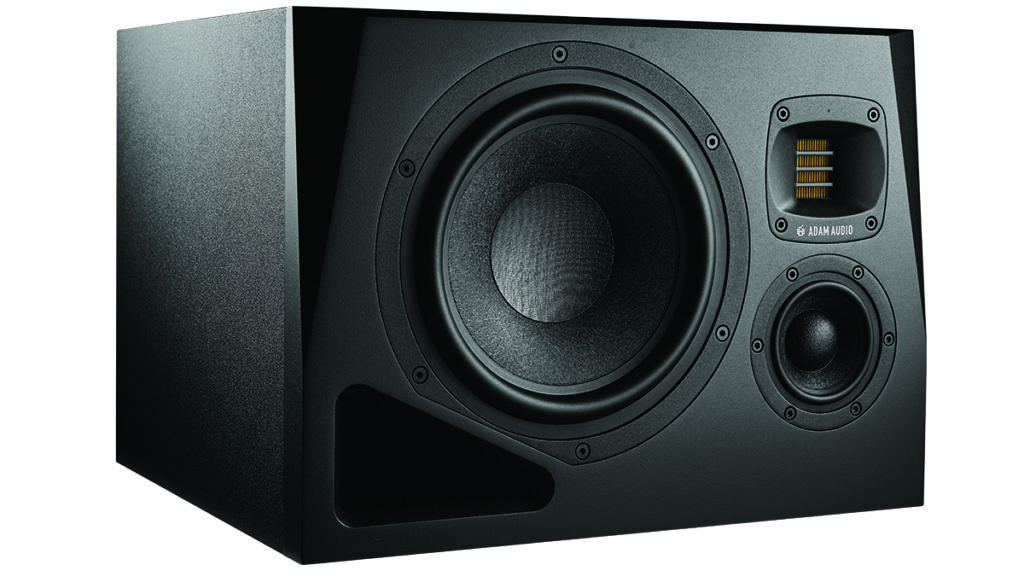
Deep, Clean Bass That Doesn’t Smear Vocals (with specs + the “stuff people skip”)
The ADAM A8H is a 3-way, tri-amped 8″ studio monitor designed to deliver real low-end extension while keeping mids/treble clean—exactly why it works so well as a “bass speaker” at home without turning boomy.
Key specs that actually matter (not marketing):
- Drivers: 8″ MLM woofer + 3.5″ midrange + X-ART tweeter (rotatable HPS waveguide)
- Power: 340W peak total (tri-amped)
- Frequency response: 31 Hz–45 kHz (-6 dB) / 34 Hz–41 kHz (-3 dB)
- Max SPL (peak): ~105 dB @1m
Why the bass stays “pure” instead of muddy
The 3-way design is the secret sauce. A lot of 2-way speakers ask the woofer to cover bass and much of the midrange, which is where vocals live—so when bass gets busy, voices smear. The A8H hands vocals to a dedicated mid driver and crosses over around 400 Hz and 3 kHz, so bass energy doesn’t bully the midrange.
Important things people skip (that change real-world results)
- Left/Right versions exist—buy the correct pair so imaging is consistent.
- Waveguide rotates: if you place them horizontally/vertically, rotate it properly or your dispersion/sweet spot suffers.
- DSP + room/boundary tuning can prevent “too much bass” when near walls—this is how you keep bass deep without
Yamaha HS8
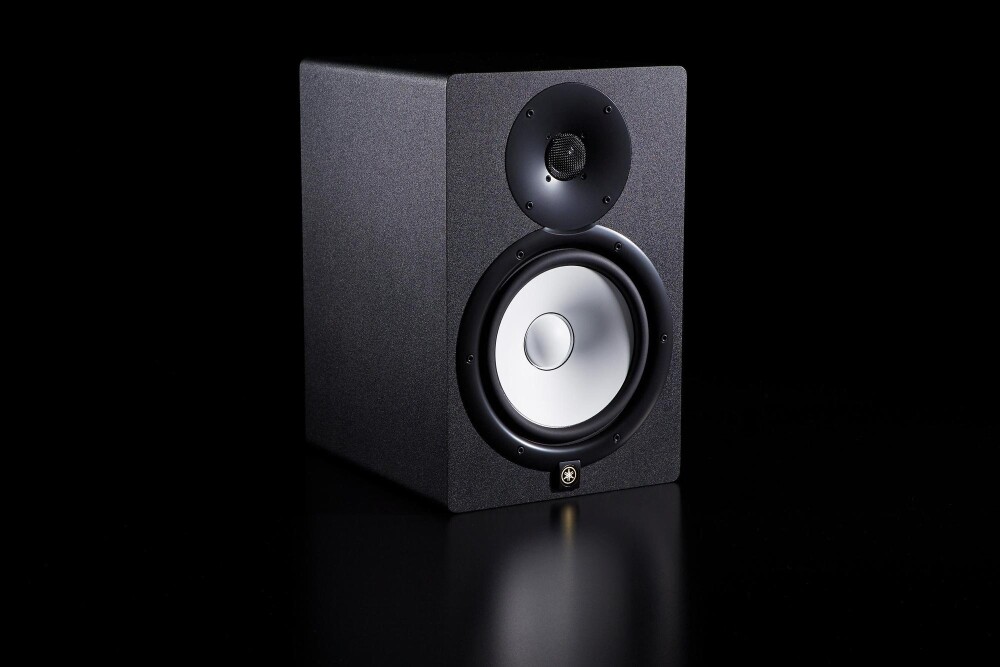
Tight, Honest Bass That Doesn’t Fake Warmth (with specs + what most people miss)
The Yamaha HS8 is a 2-way, bi-amped 8″ studio monitor built for clean, controlled low-end rather than boosted excitement. It’s popular in home setups because it delivers real bass extension without artificially thickening the mid-bass.
Key specs that actually matter (not marketing):
Drivers: 8″ cone woofer + 1″ dome tweeter
Power: 120W total (75W LF / 45W HF bi-amped)
Frequency response: 38 Hz–30 kHz
Rear bass reflex port
Room Control & High Trim switches
Why the bass stays tight instead of bloated
The HS8 avoids exaggerating the 80–120Hz region. Instead of adding warmth, it focuses on fast transient response and clean decay.
Kick drums feel precise.
Bass guitars sound structured.
Vocals remain forward and clear.
Because the woofer isn’t artificially boosted, it doesn’t spill into the lower mids.
Important things people skip
- Rear port = placement matters. Keep at least 8–12 inches from walls.
• Use the Room Control switch if placing near walls.
• It benefits from basic acoustic treatment more than warmer speakers.
The HS8 is ideal for listeners who want bass depth without coloration.
Kali Audio IN-8 V2
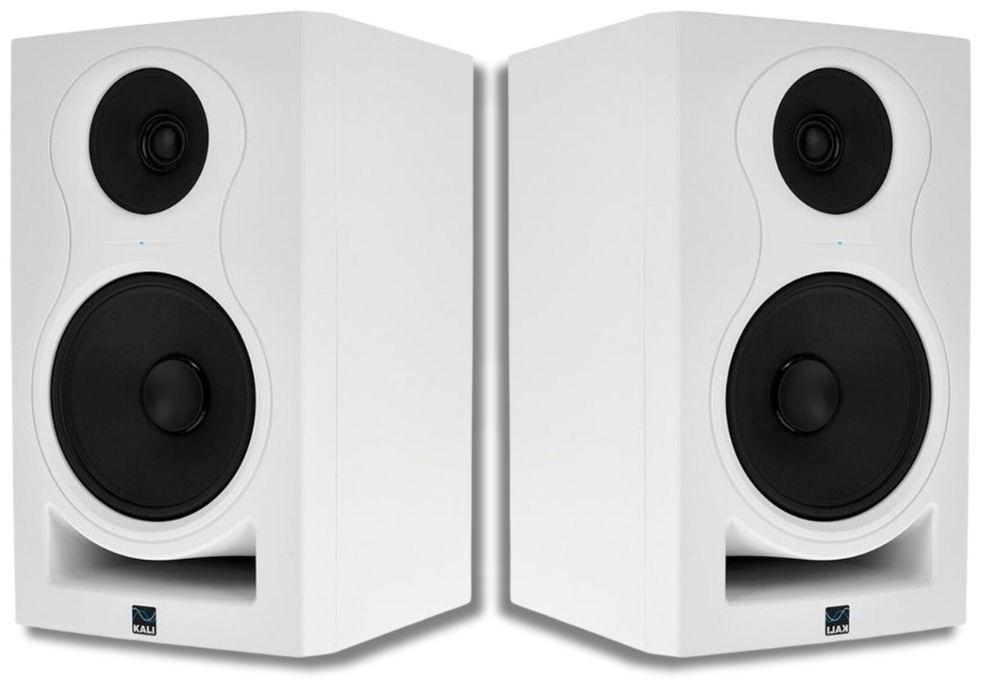
Deep, Controlled Bass With 3-Way Precision (and easier placement)
The Kali IN-8 V2 is a true 3-way active monitor — rare at its price. That matters more than people realize.
Key specs that actually matter:
Drivers: 8″ woofer + 4″ midrange + 1″ tweeter (coaxial mid/tweeter)
Power: 140W total
Frequency response: approx. 37 Hz–25 kHz
Front-firing port
Boundary EQ switches
Why bass doesn’t smear vocals
Because it’s a 3-way design, the woofer only handles low frequencies. The midrange driver takes over above that.
That separation means:
- Bass hits hard
• Vocals stay clear
• Imaging stays stable
The front port also makes placement easier than rear-ported speakers.
Important things people skip
- The boundary EQ switches must be set correctly.
• Front port doesn’t mean “ignore placement” — corners still boost bass.
• Coaxial design improves phase alignment, so toe-in matters.
The IN-8 V2 is one of the most balanced “deep but clean” 8-inch monitors available.
KRK Rokit 8 G5
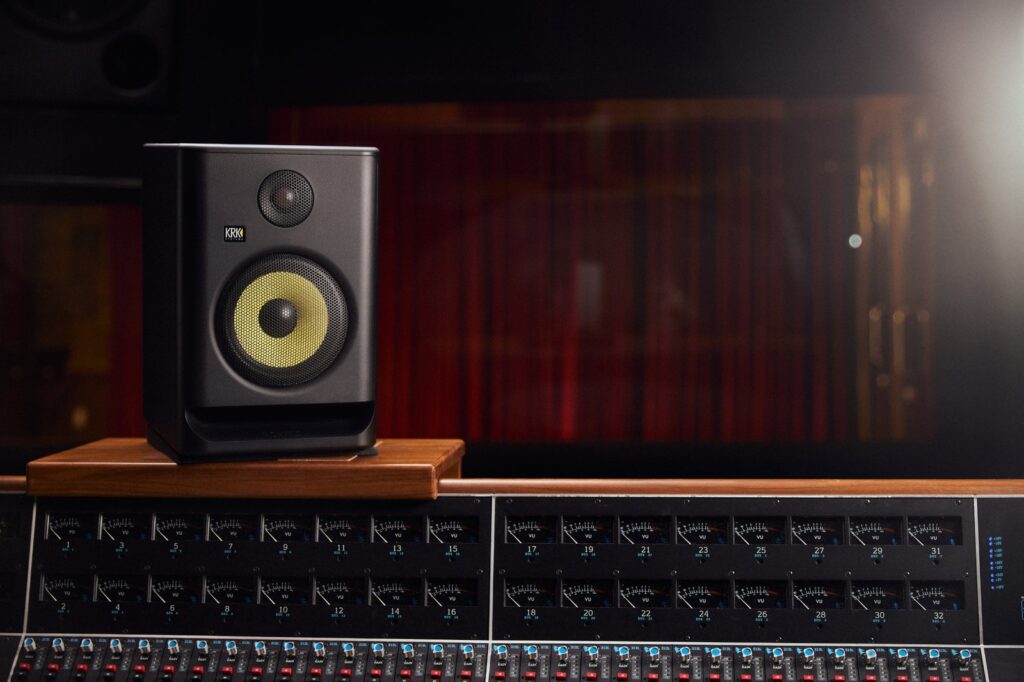
Punchier, Warmer Bass With DSP Control
The KRK Rokit 8 G5 is an 8″ bi-amped active monitor that leans slightly warmer in the low end compared to Yamaha or Adam.
Key specs that matter:
Drivers: 8″ woven Kevlar woofer + 1″ tweeter
Power: 203W total (bi-amped Class D)
Frequency response: approx. 36 Hz–40 kHz
Rear bass port
Built-in DSP with LCD EQ presets
Why it feels fuller
The Rokit 8 G5 slightly emphasizes mid-bass. That creates:
- Thicker kick drum impact
• More apparent warmth
• Stronger room-filling presence
It’s not as surgically tight as Adam A8H, but many home listeners prefer this livelier character.
Important things people skip
- Rear port + wall proximity = big bass boost.
• Always adjust DSP EQ based on placement.
• Kevlar woofer tightens slightly after break-in.
The Rokit 8 G5 is ideal for listeners who want clarity with a bit of extra punch.
Klipsch The Sevens
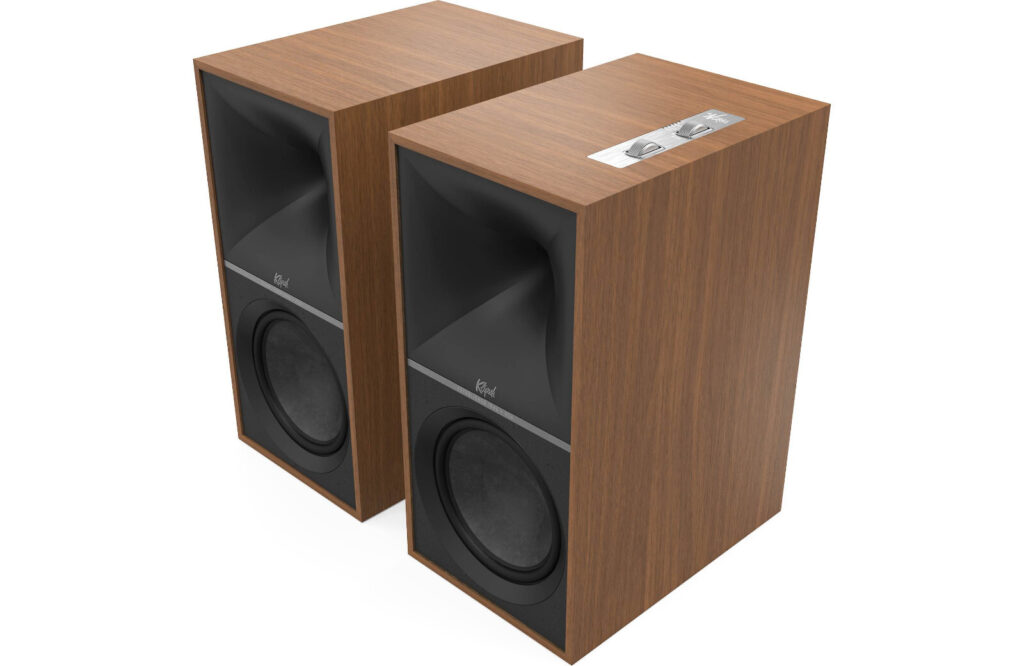
Big, Room-Filling Bass Without a Separate Sub (with specs + what most people overlook)
The Klipsch The Sevens are powered stereo speakers designed for living rooms, not studios. They focus on impact and engagement while keeping clarity intact — which is why they work so well as a bass-forward home stereo solution.
Key specs that actually matter (not marketing):
Drivers: 6.5″ long-throw woofer + 1″ titanium compression driver (Tractrix horn)
Amplification: 200W RMS total / up to 400W peak
Frequency response: approx. 39 Hz–25 kHz
Rear bass reflex port
Built-in DAC, HDMI ARC, Bluetooth, phono preamp
Why the bass feels larger than expected
The long-throw woofer allows deeper excursion than typical bookshelf speakers. Combined with the horn-loaded tweeter’s high efficiency, this creates:
- Strong mid-bass punch
• Wide room coverage
• High dynamic headroom
• Engaging, forward presentation
Unlike flat studio monitors, The Sevens intentionally add energy in the mid-bass region for excitement.
Why they don’t sound muddy
The horn tweeter maintains clarity even at higher volume. That projection prevents bass from overwhelming vocals.
Bass is full — but still separated.
Important things people skip
- Rear port = avoid placing flush against walls.
• High sensitivity means they get loud quickly — careful volume control matters.
• These are tuned for enjoyment, not strict neutrality.
The Sevens are ideal for listeners who want impactful, living-room bass without adding a separate subwoofer.
Best Bass Studio & Powered Stereo Speakers (2026 Comparison Sheet)
| Model | Design Type | Woofer Size | Amplification | Frequency Response | Bass Character | Placement Sensitivity | Best For |
| ADAM Audio A8H | 3-Way, Tri-Amped | 8″ | 340W peak | 31 Hz–45 kHz (-6dB) | Deep, tight, controlled | Moderate (DSP helps) | Accurate deep bass without smear |
| Yamaha HS8 | 2-Way, Bi-Amped | 8″ | 120W total | 38 Hz–30 kHz | Tight, honest, leaner | High (rear port) | Clean, disciplined bass |
| Kali IN-8 V2 | 3-Way, Bi-Amped | 8″ | 140W total | ~37 Hz–25 kHz | Deep, balanced, stable | Low-Moderate (front port) | Bass + vocal clarity balance |
| KRK Rokit 8 G5 | 2-Way, Bi-Amped + DSP | 8″ | 203W total | ~36 Hz–40 kHz | Warm, punchy, energetic | Moderate (rear port + DSP) | Fun home listening |
| Klipsch The Sevens | Powered Hi-Fi | 6.5″ | 200W RMS | ~39 Hz–25 kHz | Big, room-filling, lively | Moderate (rear port) | Living-room impact |
What Actually Separates Them
Deepest Extension
ADAM A8H → Reaches lowest with control
Cleanest Midrange Under Heavy Bass
ADAM A8H & Kali IN-8 V2 (3-way advantage)
Warmest / Most Fun
KRK Rokit 8 G5
Most Honest / Least Colored
Yamaha HS8
Best Living Room Energy
Klipsch The Sevens
Important Reality Check (Most People Ignore This)
- Room size matters more than specs.
An 8-inch woofer in a large untreated room won’t feel deep. - Rear ports amplify bass near walls.
Placement can add +3 to +6 dB low-end boost. - 3-way designs handle bass cleaner at volume.
They prevent vocal masking when bass hits hard. - Subwoofer integration beats bigger speakers in large rooms.
If you want true sub-30Hz physicality, add a sub.
Best Bass Speaker Choice by Room Size (2026 Guide)
Because here’s the truth most reviews skip:
Room size affects bass more than speaker specs.
A powerful 8-inch monitor in a large untreated living room will sound weak.
A smaller room can make moderate speakers sound huge.
Let’s break this down properly.
Small Room (Up to 150 sq ft / 14 m²)
Best Choice:
Yamaha HS8
or
Kali Audio IN-8 V2
Why
In small rooms:
- Bass reflects quickly
• Low frequencies build up easily
• Too much power becomes muddy
The HS8 gives tight, controlled bass without overloading the space.
The IN-8 V2 offers slightly fuller extension but remains controlled thanks to its 3-way design.
Setup Tip Most People Skip
Keep speakers:
• 8–12 inches from rear wall
• Off the desk (use stands or isolation pads)
• Slight toe-in toward listening position
Avoid corners — that adds uncontrolled boom.
Medium Room (150–300 sq ft / 14–28 m²)
Best Choice:
Adam Audio A8H
or
KRK Rokit 8 G5
Why
Medium rooms allow 8-inch woofers to breathe.
The A8H delivers:
- Deep extension
• Clean transient response
• Professional-grade clarity
The Rokit 8 G5 gives:
- Stronger perceived mid-bass punch
• More “fun” energy
Important Detail
In medium rooms, DSP tuning becomes extremely valuable.
The A8H’s boundary controls help prevent overhang.
Large Room (300+ sq ft / 28m²+)
Best Choice Without Sub:
Klipsch The Sevens
Best Choice With Sub:
Adam Audio A8H + Subwoofer
Why
Large rooms absorb bass.
Even strong 8-inch monitors will struggle below 35Hz without help.
The Sevens fill space well thanks to:
- Horn-loaded projection
• Long-throw woofer
• Higher perceived loudness
But for true deep bass in large rooms, a subwoofer is physics — not preference.
When You Absolutely Need a Subwoofer
You should consider adding a sub if:
- You want chest-level impact below 30Hz
• You watch movies with heavy LFE
• Your room is large
• You feel the bass is “there but not physical”
Even the best 8-inch speaker cannot replace a 10–12 inch dedicated sub in deep extension.
Quick Room-Based Recommendations
Small Desk Setup → HS8
Medium Studio Room → A8H
Living Room Fun Setup → The Sevens
Balanced Budget Setup → IN-8 V2
Energetic Home Listening → Rokit 8 G5
Best Subwoofer Pairings for These Bass Speakers (2026)
Because here’s the reality:
Even the best 8-inch monitor cannot reproduce true sub-30Hz physical air movement in a medium or large room.
If you want:
- Chest pressure
• Cinematic depth
• EDM drop authority
• Room-shaking extension
You need a properly integrated subwoofer.
But integration is everything. A bad crossover setup will destroy clarity.
Let’s do this correctly.
For Adam Audio A8H
Best Pairing Philosophy: Clean Extension, Not Boom
The A8H already reaches low. So you don’t want a sub that overlaps aggressively in mid-bass.
Look for:
- 10″ or 12″ sealed sub
• Fast transient response
• Adjustable crossover (60–80Hz sweet spot)
Why Sealed Works Best Here
Sealed subs:
- Have tighter decay
• Blend better with studio monitors
• Avoid overhang
Ported subs can sometimes feel slower compared to the A8H’s tight woofer.
Integration Tip Most People Skip
Set crossover around 70Hz, not 100Hz.
Let the A8H handle upper bass.
Let the sub handle deep extension.
That keeps bass layered and clean.
For Yamaha HS8
Best Pairing Philosophy: Add Depth Without Coloring
HS8 is leaner in mid-bass. A sub helps add weight.
Recommended:
- 10″ sealed or controlled ported
• Adjustable phase alignment
• Variable crossover
Crossover range: 75–85Hz.
Important: Use the HS8’s room control switch when adding a sub to avoid overlap buildup.
For Kali Audio IN-8 V2
Best Pairing Philosophy: Preserve 3-Way Clarity
The IN-8 V2 has excellent midrange separation. Don’t ruin it with sloppy sub tuning.
Best:
- Tight, musical sub
• Front-firing driver
• Good phase control
Front port on IN-8 makes integration slightly easier near walls.
Crossover: 70–80Hz.
For KRK Rokit 8 G5
Best Pairing Philosophy: Control the Warmth
Because Rokit already has elevated mid-bass, pairing it with a boomy sub can cause mud.
Recommended:
- Tight sealed sub
• Lower crossover (60–70Hz)
• Careful EQ adjustment
Lower crossover avoids doubling the mid-bass hump.
For Klipsch The Sevens
Best Pairing Philosophy: Extend, Don’t Overwhelm
The Sevens are already lively.
A sub here should:
- Extend low frequencies
• Not exaggerate 80–100Hz
• Blend seamlessly
Crossover around 60–70Hz works best.
Avoid high crossover settings — that makes the system sound bloated.
Subwoofer Size Guide
Room Under 150 sq ft → 10″ is enough
150–300 sq ft → 12″ recommended
Large Room → 12″ minimum, possibly dual subs
Critical Setup Advice (Most Important Section)
Place the sub slightly off-center, not in the corner.
Use the “sub crawl” method to find best placement.
Adjust phase alignment carefully — this changes bass tightness dramatically.
Set volume so bass feels integrated, not dominant.
If you hear the sub separately, it’s set wrong.
Best Bass Studio & Powered Stereo Speakers (2026)
| Speaker | Design | Woofer | Power | Low-End Extension | Bass Character | Vocal Stability Under Heavy Bass | Room Flexibility | Best For |
| ADAM Audio A8H | 3-Way, Tri-Amped | 8″ MLM | 340W Peak | ~31 Hz | Deep, tight, extended, controlled | Excellent (dedicated midrange prevents smear) | Good (DSP boundary tuning helps) | Deep accurate bass without muddiness |
| Yamaha HS8 | 2-Way, Bi-Amped | 8″ | 120W | ~38 Hz | Tight, honest, slightly lean | Very Good (no artificial warmth) | Sensitive (rear port placement critical) | Clean reference listening |
| Kali IN-8 V2 | 3-Way, Bi-Amped | 8″ | 140W | ~37 Hz | Balanced, stable, slightly full | Excellent (true 3-way separation) | Easier (front port + boundary EQ) | Balanced bass + clarity |
| KRK Rokit 8 G5 | 2-Way, Bi-Amped + DSP | 8″ Kevlar | 203W | ~36 Hz | Warm, punchy, energetic | Good (slight warmth in mids) | Moderate (rear port + DSP tuning needed) | Fun, engaging home listening |
| Klipsch The Sevens | Powered Hi-Fi | 6.5″ Long-Throw | 200W RMS | ~39 Hz | Big, lively, room-filling | Good (horn projection keeps vocals forward) | Moderate (rear port, avoid corners) | Living room impact & entertainment |
FAQs
Are studio speakers good for bass at home?
Yes — if you choose the right size.
Modern 8-inch studio monitors like Adam Audio A8H or Kali Audio IN-8 V2 deliver deep, controlled bass without exaggeration.
They don’t boost bass artificially — they extend lower with clarity. That’s why they sound clean instead of boomy.
For small rooms, they are often better than typical “bass-boosted” consumer speakers.
Is an 8-inch woofer enough for deep bass?
For small to medium rooms — yes.
An 8-inch monitor can comfortably reach into the mid-30Hz range.
However, for:
- Large rooms
• Movie-level sub-bass
• Chest-shaking impact below 30Hz
You will need a subwoofer.
Physics always wins.
Why do 3-way speakers handle bass better?
Speakers like Adam Audio A8H and Kali Audio IN-8 V2 use dedicated midrange drivers.
That means:
- The woofer handles low frequencies only
• Vocals don’t get masked
• Bass doesn’t smear mids
This keeps the sound pure even at higher volume.
Why does bass become muddy near walls?
Rear-ported speakers like:
- Yamaha HS8
• KRK Rokit 8 G5
can experience bass buildup if placed too close to walls or corners.
Walls reflect low frequencies, increasing bass energy by 3–6 dB.
Solution:
- Leave at least 8–12 inches of space
• Use room control switches
• Avoid corners when possible
Are hi-fi speakers better for bass than studio monitors?
Not necessarily.
Hi-fi models like Klipsch The Sevens are tuned for engagement and warmth.
Studio monitors are tuned for accuracy.
If you want:
- Precise bass → Studio monitors
• Lively, room-filling excitement → Hi-fi powered speakers
It depends on your listening goal.
Do I need a subwoofer for music?
Not always.
For most music genres in small rooms, an 8-inch monitor is enough.
You should consider a sub if:
- You want sub-30Hz extension
• You listen to bass-heavy EDM or cinematic scores
• Your room is large
What’s more important: wattage or woofer size?
Woofer size and cabinet design matter more than raw wattage.
A well-designed 8-inch speaker at 120W can outperform a poorly designed 200W speaker.
Power provides headroom.
Driver design determines bass quality.
Can too much bass reduce clarity?
Yes — if:
- The crossover isn’t well designed
• The woofer overlaps midrange
• The room amplifies low frequencies
That’s why 3-way systems often sound cleaner under heavy bass.
Which is the safest all-rounder?
If you want balance without risk:
→ Kali Audio IN-8 V2
It combines depth, clarity, easier placement, and strong value.
Which is best for pure deep bass accuracy?
→ Adam Audio A8H
It extends lowest and maintains tight control under heavy load.